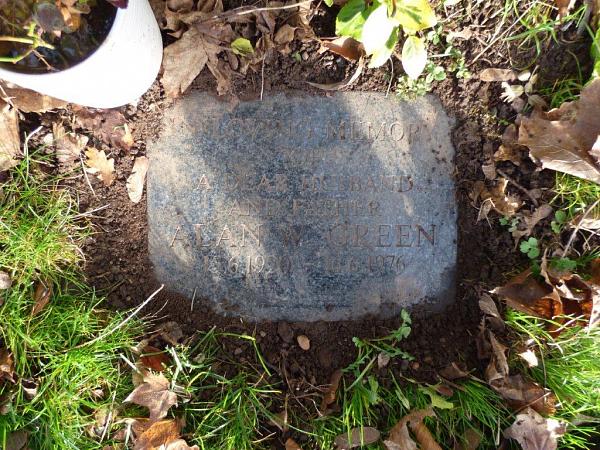
Born in Coventry in 1920,
Alan Green was a 20-year-old Pharmacy student (at Leicester School of Pharmacy) when he joined the RAF Volunteer Reserve at RAF Cardington (home of the airship hangars) on the 1st May 1940. Having originally been earmarked for Observer/Pilot, he was selected as a Navigator, as a result of colour blindness. He was mobilised on 20th September 1940, following which he was sent to Torquay in Devon to complete his basic training. On 14th November 1940, Alan heard rumours that thousands had been killed in his home city in the biggest single raid on the UK in WW2. After two hours in a phone box the following day, he finally got through to Coventry to learn that there were no Greens on the casualty list, although 60% had not been identified at that stage. In a subsequent heartfelt letter to his parents, he reassured his father that they could rebuild the family business, which had suffered terrible damage but, thankfully, no casualties.
On 15th December 1940, he was sent by ship to Canada to undertake his airborne training as part of the Commonwealth Air Training Plan. This scheme trained over 160,000 RAF aircrew, the majority of whom trained in Canada.
After some seven months, he returned to the UK to complete his flying training at several Operational Training Units (OTUs). OTU 12 was at RAF Benson on the Fairey Battle, while OTUs 20 and 27 were at Lossiemouth and Lichfield respectively on the Wellington. On completion of his training, he was transferred to 218 Squadron (part of 3 Group, Bomber Command) on 8th December 1941 at RAF Marham in Norfolk.
After his first operational mission to Ostend on 16th December 1941, Alan undertook a further 21 operations in Bomber Command. The first seven missions, which were on the twin-engine Wellington bomber, included participation in the RAF's action against the "Channel Dash" of three German warships (Scharnhorst, Gneisenau and Prinz Eugen) on 12th February 1942.
The remaining 14 operations were aboard the mighty Stirling, the RAF's first four-engine bomber. These included a top-secret mission against the Skoda factory in the old Czechoslovakia on 25th April 1942 (supported by Czech resistance fighters who are commemorated in Leamington) and the first 1,000-bomber raid on Cologne on 30th May 1942, when Alan's crew had an Air Vice Marshal on board as an observer.
Alan was shot down twice during his time in Bomber Command, on both occasions in Stirlings. The first was on the night of 4th/5th May 1942 in R9313, when they were mistaken for an enemy aircraft by the RAF and shot down in error by a Hurricane flying with a twin-engine Havoc fitted with a large searchlight in the nose. Thankfully, all the crew baled out successfully.
The second occasion, in W7530, was by a German night fighter over Holland on 20th/21st June 1942. Although three of the crew of eight were killed (the youngest casualty was only 19), Alan managed to bale out with four colleagues. After a brief period in hiding, during which he was helped by Dutch farmers, Alan was captured on a tram while making his way to Amsterdam to meet up with the Dutch Resistance.
He was eventually taken to a new POW camp in Silesia called Stalag Luft III, which became famous for the "Wooden Horse" escape and the "Great Escape".
In late January 1945, the camp was evacuated at short notice and the POWs were forced to travel some 250 km, half of which was on foot and the rest in slow-moving cattle trucks. This became known as the "Long March" of POWs, during what was the worst winter in Germany for 50 years, with temperatures falling as low as �'25 degrees Celsius.
Alan ended up in a vastly overcrowded POW camp 60 km southwest of Berlin, from where he was eventually liberated by the Red Army, but only after the British had handed over to the Russians thousands of Cossack prisoners, all of whom had fought for Germany and faced execution on their return to Russia.
Upon repatriation to the UK in late May as part of "Operation Exodus", Alan was interrogated by MI9 at Cosford before returning to Coventry to resume his pharmacy studies. After completing his studies, he joined the family business, Greens Chemists, whose flagship shop was at the bottom of Hertford Street.
He went on to marry Gail in 1951, whom he had met at Kenilworth Rugby Club while she was over from Canada visiting relatives in Coventry. Alan and Gail went on to have two sons, William and Stuart, and moved to Stoneleigh in 1964.
Sadly, Alan died suddenly on his 56th birthday in 1976, having suffered a heart attack.
We are grateful to Stuart Green for this narrative.